
Introduction
Culture media are one of the foundations of clinical microbiology. They provide microorganisms with the nutrients and environmental conditions required for growth and, in many cases, contain specific components that allow laboratory scientists to select, differentiate, or presumptively identify organisms.
Choosing a culture medium is therefore not simply a matter of remembering the names of different agar types. The appropriate medium should be selected according to the specimen type, suspected microorganism, clinical information, and purpose of the investigation.
For example, the media required for a urine specimen will differ from those commonly selected for a stool, respiratory, wound, or fungal specimen.
What Are Culture Media?
Culture media are prepared nutrient materials used to cultivate microorganisms under controlled laboratory conditions. They may be supplied as solid media, such as agar plates, or as liquid media such as broths.
Depending on their formulation, culture media may be described as enriched, selective, differential, enrichment, transport, or general-purpose media. Some media have more than one function.
Enriched Media
Enriched media contain additional nutrients that support organisms with demanding nutritional requirements. They are particularly useful when the suspected pathogen may not grow adequately on basic media.
Selective Media
Selective media contain substances that inhibit certain groups of microorganisms while allowing the organisms of interest to grow. This is particularly useful when the specimen is expected to contain a mixture of microorganisms.
Differential Media
Differential media contain indicators or substrates that allow microorganisms to be distinguished according to biochemical characteristics, such as carbohydrate fermentation or hydrogen sulfide production.
Common Culture Media
Blood Agar
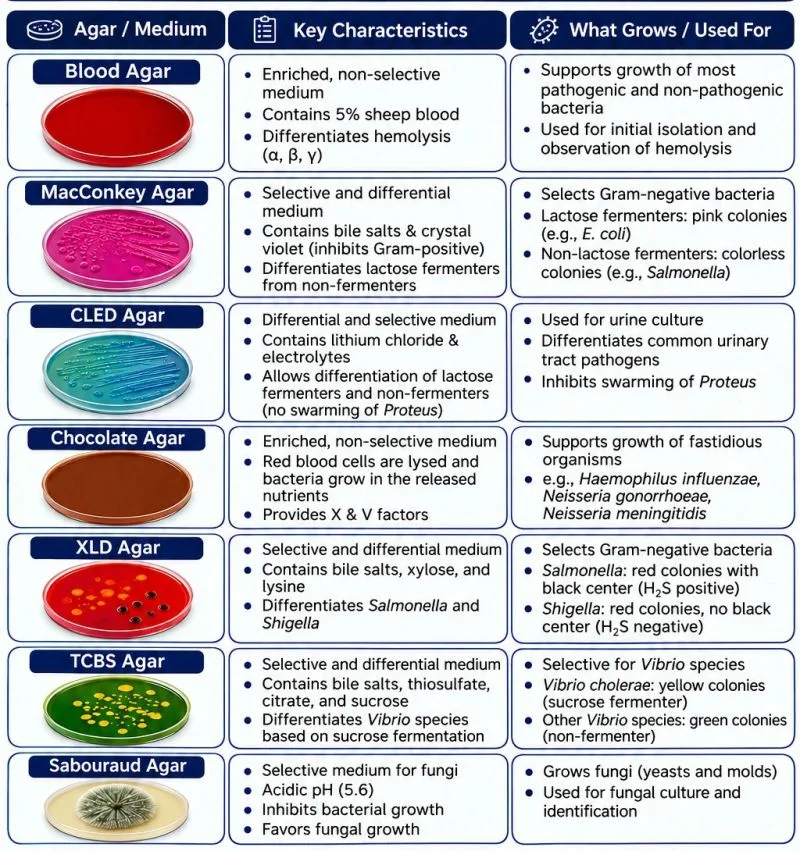
Blood agar is an enriched and differential medium widely used for the routine isolation of bacteria. It supports the growth of many clinically important organisms and can demonstrate hemolysis around colonies.
The major hemolytic patterns include:
- Alpha hemolysis: partial hemolysis, often producing a greenish discoloration.
- Beta hemolysis: complete hemolysis, producing a clear zone around the colony.
- Gamma hemolysis: absence of significant hemolysis.
Hemolysis can provide useful presumptive information, but it should not be used as the sole basis for bacterial identification.
MacConkey Agar
MacConkey agar is a selective and differential medium commonly used for the isolation of many Gram-negative bacteria.
It contains components that inhibit many Gram-positive organisms and allows differentiation based on lactose fermentation.
- Lactose fermenters generally produce pink to red colonies.
- Non-lactose fermenters generally produce pale or colorless colonies.
MacConkey agar is particularly useful for specimens where Gram-negative enteric organisms are suspected.
CLED Agar
Cystine-Lactose-Electrolyte-Deficient (CLED) agar is commonly used for urine culture. It supports the growth of many urinary pathogens while its electrolyte-deficient formulation helps reduce the extensive swarming associated with Proteus species.
This makes individual colonies easier to observe and enumerate during urine culture.
Chocolate Agar
Chocolate agar is an enriched medium prepared by heating blood, causing red blood cells to lyse and release important growth factors.
It is useful for the isolation of fastidious organisms such as Haemophilus and Neisseria species, which require nutrients or growth factors that may not be adequately available in routine media.
XLD Agar
Xylose Lysine Deoxycholate (XLD) agar is a selective and differential medium commonly used for the isolation of enteric pathogens, particularly Salmonella and Shigella.
It differentiates organisms based on biochemical reactions involving xylose fermentation, lysine decarboxylation, and hydrogen sulfide production. The resulting colony characteristics provide useful presumptive information before confirmatory identification.
TCBS Agar
Thiosulfate-Citrate-Bile Salts-Sucrose (TCBS) agar is designed for the selective isolation of Vibrio species.
It is particularly useful when Vibrio cholerae or other clinically relevant vibrios are suspected. The medium suppresses many competing organisms and differentiates vibrios partly according to sucrose fermentation.
Sabouraud Dextrose Agar
Sabouraud Dextrose Agar (SDA) is widely used in medical mycology for the cultivation of fungi, including yeasts and molds.
Its formulation favors fungal growth and can be used when a fungal infection is suspected. Depending on the laboratory's protocol, antimicrobial agents may be incorporated into certain fungal media to suppress bacterial contamination.
Why Medium Selection Matters
The choice of culture medium directly influences the laboratory's ability to recover and recognize microorganisms. An inappropriate medium may fail to support the target organism, allow excessive growth of competing organisms, or make differentiation difficult.
Medium selection should therefore consider:
- Specimen type and quality
- Clinical information
- Suspected pathogens
- Expected normal flora
- Required incubation conditions
- Whether selective or differential properties are needed
- The laboratory's validated procedures
Culture Medium Is Not the Final Identification
Growth on a particular medium usually provides presumptive information rather than a definitive identification.
For example, a colony showing a particular color or hemolytic pattern may suggest a group of organisms, but additional testing may be required. Depending on the organism and laboratory resources, identification can involve Gram staining, biochemical testing, antigen detection, MALDI-TOF mass spectrometry, molecular methods, or other validated techniques.
This distinction is important because colony morphology can overlap between different organisms.
Culture Media and Specimen Quality
Even the best culture medium cannot compensate for a poor-quality specimen. Proper patient preparation, specimen collection, labeling, transport, storage, and timely processing are essential parts of the pre-analytical process.
For example, contamination during specimen collection may result in mixed growth that complicates interpretation. Similarly, delays in processing may allow some organisms to multiply while others lose viability.
Therefore, culture interpretation should always consider both the medium and the specimen.
Quick Revision
| Culture Medium | Main Purpose or Association |
|---|---|
| Blood Agar | Broad bacterial isolation and hemolysis |
| MacConkey Agar | Gram-negative bacteria and lactose fermentation |
| CLED Agar | Urine culture and reduced Proteus swarming |
| Chocolate Agar | Fastidious organisms |
| XLD Agar | Enteric pathogens such as Salmonella and Shigella |
| TCBS Agar | Vibrio species |
| SDA | Yeasts and molds |
Key Takeaway
Choosing the right culture medium is an essential part of clinical microbiology because the formulation of the medium influences which microorganisms can grow and which characteristics can be observed.
The goal is not simply to memorize culture media. A competent laboratory scientist should understand why a particular medium is selected, what it is designed to demonstrate, and how its findings should be interpreted alongside other laboratory results.