
Introduction
Quality is one of the most important foundations of a medical laboratory. Laboratory results influence diagnosis, treatment, monitoring, screening, transfusion decisions, and public health interventions. For this reason, laboratory results must be as accurate, reliable, and timely as possible. WHO emphasizes that quality management must address all aspects of laboratory operation rather than focusing only on the analytical testing stage.
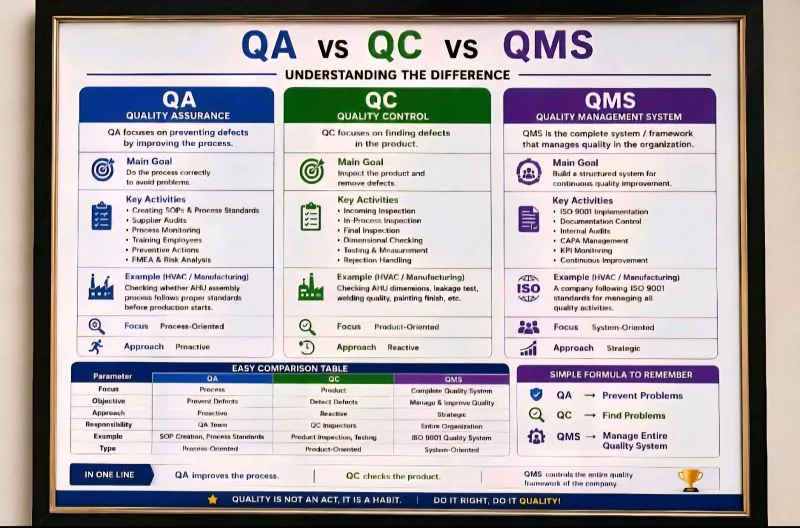
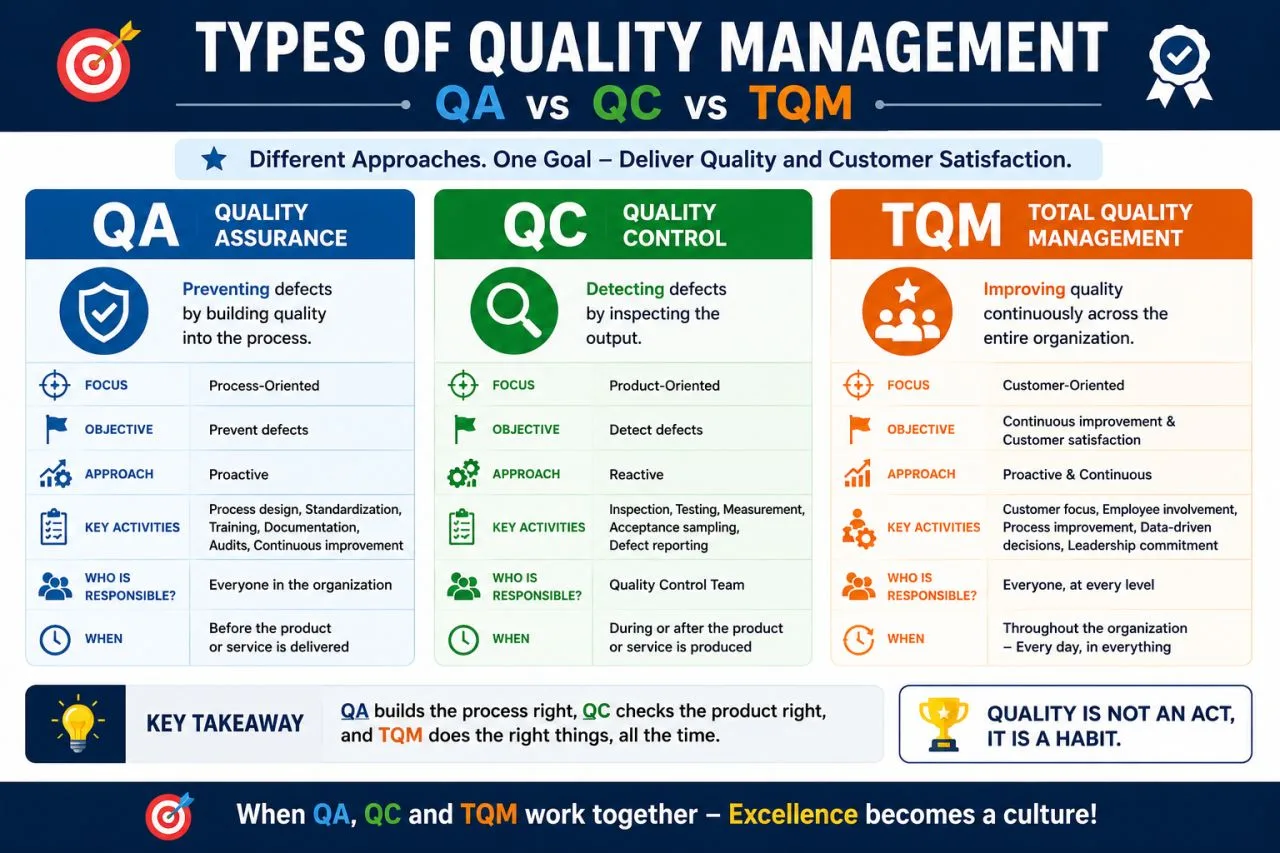
Three terms frequently used in laboratory quality management are Quality Assurance (QA), Quality Control (QC), and Quality Management System (QMS).
Although these concepts are closely related, they are not interchangeable.
Quality Assurance (QA)
Quality assurance is a broad and proactive approach used to provide confidence that quality requirements will be fulfilled.
QA focuses on processes and prevention. Rather than waiting for an error to occur, QA aims to design and manage laboratory processes in a way that reduces the likelihood of errors.
Examples include:
- Development and implementation of SOPs
- Staff training
- Competency assessment
- Method validation and verification
- Equipment qualification and maintenance
- Internal audits
- External quality assessment
- Quality indicator monitoring
- Risk management
- Corrective and improvement activities
A simple way to remember QA is:
QA asks: Have we designed and managed our processes properly so that quality can be achieved consistently?
WHO describes QA as including activities such as process control, assessment, QC, EQA, data review, and continual quality improvement.
Quality Control (QC)
Quality control refers to operational techniques used to monitor whether a testing process is performing as intended and to detect errors that may affect results.
In a clinical laboratory, QC may involve the use of control materials, monitoring analytical performance, reviewing control charts, identifying shifts or trends, and investigating unacceptable control results.
QC is therefore particularly important during the analytical phase of testing.
A simple way to remember QC is:
QC asks: Is the testing process performing acceptably right now?
QC can detect problems such as reagent deterioration, instrument malfunction, calibration problems, environmental effects, or operator-related analytical errors.
Quality Management System (QMS)
A Quality Management System is the overall framework used to organize, control, document, monitor, assess, and continually improve laboratory activities.
WHO's Laboratory Quality Management System framework covers the laboratory as a whole and is organized around the essential components required to manage quality across laboratory operations.
Important areas include:
- Organization and management
- Personnel
- Equipment
- Purchasing and inventory
- Process management
- Information management
- Documents and records
- Assessment
- Nonconformity management
- Customer focus
- Continual improvement
The Three Phases of Laboratory Testing
A strong QMS considers the entire testing pathway.
1. Pre-analytical Phase
This includes activities before the actual examination, such as:
- Patient identification
- Test request and registration
- Patient preparation
- Specimen collection
- Correct labeling
- Specimen storage
- Transportation
- Specimen acceptance or rejection
Errors in this phase can affect the quality of the final result even if the analytical system performs perfectly.
2. Analytical Phase
This is the actual examination of the specimen and includes:
- Sample preparation
- Reagent preparation
- Instrument operation
- Calibration
- Internal QC
- Testing procedures
- Analytical verification
3. Post-analytical Phase
This includes activities after testing, such as:
- Result review
- Authorization or validation
- Reporting
- Communication of critical results
- Result interpretation where appropriate
- Record retention
- Sample storage or disposal
WHO's Laboratory Quality Stepwise Implementation tool similarly describes the laboratory's primary process as pre-analytical, analytical, and post-analytical stages.
How QA, QC, and QMS Work Together
These three concepts should be viewed as interconnected.
QMS → Provides the overall structure
QA → Builds and maintains quality within processes
QC → Monitors testing performance and detects analytical problems
For example, consider a clinical chemistry laboratory.
The laboratory may have an SOP describing how a chemistry analyzer should be operated. Staff are trained and assessed for competency. The analyzer is maintained and calibrated according to defined procedures. These activities form part of the broader quality system.
The laboratory then runs control materials and monitors their results using appropriate QC procedures. If QC results fall outside acceptable limits, the laboratory investigates before releasing affected patient results.
The policies, SOPs, training records, maintenance records, QC records, audits, corrective actions, quality indicators, and continual improvement activities collectively contribute to the laboratory's QMS.
Why QC Alone Is Not Enough
A laboratory can have acceptable analytical QC results and still produce an incorrect or clinically misleading result if problems occur elsewhere.
For example:
- The wrong patient may be identified.
- The wrong specimen may be collected.
- A specimen may be mislabeled.
- A specimen may be transported incorrectly.
- A result may be entered incorrectly.
- A critical result may not be communicated promptly.
This demonstrates why laboratory quality cannot be reduced to analytical QC alone.
WHO similarly notes that QC should form part of a comprehensive quality management system that includes appropriate training, SOPs, proficiency testing, and other quality measures.
Quality Indicators
Quality indicators provide measurable information about laboratory performance.
Examples may include:
- Specimen rejection rate
- Turnaround time
- Patient identification errors
- Critical result notification compliance
- Equipment downtime
- Proficiency testing performance
- Number of nonconformities
- Corrective action completion rate
Monitoring these indicators allows laboratory management to identify areas requiring improvement.
Nonconformities and Corrective Action
A mature QMS does not attempt to hide errors. Instead, it provides a structured way to identify, document, investigate, and correct them.
When a nonconformity occurs, the laboratory should determine what happened, assess its potential impact, identify the underlying cause, implement appropriate corrective action, and monitor whether the action was effective.
This creates a culture of continual improvement rather than simply reacting to individual mistakes.
Documentation and SOPs
Documentation is another essential part of laboratory quality.
SOPs help ensure that procedures are performed consistently and provide staff with standardized instructions. Records provide evidence that activities such as equipment maintenance, QC, training, temperature monitoring, and corrective actions were actually performed.
A useful quality principle is:
If a process is important enough to control, it should be appropriately standardized, documented, monitored, and reviewed.
QA vs QC vs QMS: Quick Comparison
| Concept | Main Focus | Typical Question |
|---|---|---|
| Quality Assurance | Processes and prevention | Are our processes designed to achieve quality? |
| Quality Control | Testing performance | Is the testing process performing acceptably? |
| Quality Management System | Entire laboratory quality framework | How do we organize and continually improve quality across the laboratory? |
Key Takeaway
Quality control is only one component of laboratory quality. Reliable laboratory services require a comprehensive QMS supported by quality assurance, quality control, assessment, documentation, competent personnel, and continual improvement.
The ultimate goal is simple: the right result, for the right patient, at the right time, using a controlled and reliable process.